



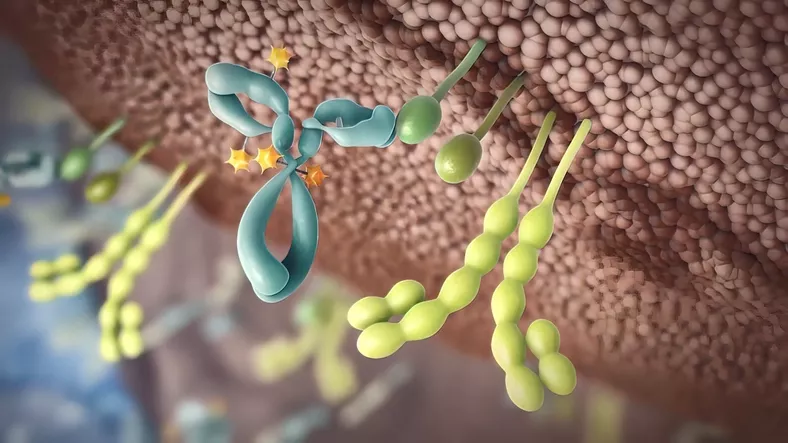
As research advances, individuals affected by multiple myeloma are being exposed to emerging cancer therapies that show promise for furthering treatment. These therapies offer fresh options for those who have relapsed, become resistant to standard treatments, or are seeking the latest options in myeloma management.
Exploring new treatments can feel overwhelming. The International Myeloma Foundation (IMF) is here to help you navigate these next-generation myeloma therapies and connect you to available clinical trial opportunities.
Understanding Immunotherapy Treatments for Myeloma
Immunotherapy is transforming how we treat multiple myeloma by strengthening the individual's immune system to better identify and destroy cancer cells. Unlike traditional treatments that directly attack cancer, immunotherapy stimulates or guides immune cells to target and eliminate myeloma cells more precisely.
Immunotherapies must bind to a receptor or target, often a protein, to produce the desired effect. Myeloma cells have many different receptors on their surfaces that can serve as drug targets, on-target. These receptors may also be present in other cells in the body, off-target. Most emerging myeloma immunotherapy treatments focus on specific proteins found on myeloma cells, such as:
- B-cell maturation antigen (BCMA)
- Fc receptor-homolog 5 (FcRH5)
- G protein-coupled receptor class C group 5 member D (GPRC5D)
- Signaling lymphocytic activation molecule family member (SLAMF7)
- Cluster of differentiation 38 (CD38)
- Cluster of differentiation 138 (CD138)
New Treatments for Multiple Myeloma
Scientific advances are rapidly expanding the options available to people with multiple myeloma, especially for those whose disease has relapsed or become resistant to existing drugs. Here are some of the most promising novel therapies for multiple myeloma, including the latest immunotherapies and targeted therapies:
Chimeric Antigen Receptor (CAR) T-Cell Therapy
CAR T-cell therapy is a personalized immunotherapy that engineers your T-cells to seek out and destroy myeloma cells. The process involves removing T-cells from your blood, genetically modifying them in a lab to better recognize specific proteins, such as BCMA, on myeloma cells, and then infusing them back into your blood.
Bispecific Antibodies (BsAbs) Therapy
Bispecific antibodies are engineered proteins that bind to two targets simultaneously. One arm attaches to a protein on myeloma cells, primarily BCMA and GPRC5D, and the other arm binds to CD3, which is a protein on the surface of your T-cells. This dual-binding action brings the immune cell into proximity with the cancer cell, activating it to attack and kill the myeloma cell. BsAb therapies are especially promising for people who have already undergone extensive treatment.
Antibody-Drug Conjugates (ADCs)
Antibody-drug conjugates combine a targeted antibody with a potent cancer-killing drug. The antibody seeks out and attaches to a specific molecule on the surface of myeloma cells. Once bound, the attached chemotherapy-like drug is delivered directly inside the cancer cell, where it is released to cause cell death. The FDA has recently approved Blenrep® (belantamab mafodotin-blmf) for the treatment of relapsed or refractory multiple myeloma.
Trispecific Antibodies (TsAbs)
Trispecific antibodies (TsAbs) are among the next-generation myeloma therapies showing promise for relapsed or refractory cases. These antibodies have two arms that bind to the surface of myeloma cells, while the third arm binds to a T cell, enabling greater precision. A recent study explores the trispecific antibody ISB 2001, which offers dual and high-affinity binding to BCMA and CD38 on myeloma cells and also binds to CD3 on T cells. This therapy has demonstrated a strong overall response rate with fewer side effects compared to BsAb therapies.
Monoclonal Antibodies (mAbs)
Monoclonal antibodies are laboratory-produced proteins that mimic the immune system's ability to fight disease. In multiple myeloma, monoclonal antibodies such as Darzalex® (daratumumab) and SARCLISA® (isatuximab-irfc) target the CD38 protein on myeloma cells. EMPLICITI® (elotuzumab) antibodies are another standard treatment, usually administered intravenously. They can also be used in combination with other drugs, such as the recently FDA-approved daratumumab and hyaluronidase-fihj for high-risk smoldering multiple myeloma.
NK Cell Therapy
NK cell therapy uses naturally occurring immune cells called natural killer (NK) cells, which are adept at identifying and killing abnormal cells. In emerging cancer therapies, NK cells may be isolated from the individual or a donor, expanded, and activated in the lab. The NK cells' ability to survive and destroy cancer cells is enhanced, and their numbers are also increased. Then, the modified NK cells are infused into the individual to help control or eliminate myeloma.
How to Find Clinical Trials for Multiple Myeloma Emerging Therapies
If you are interested in participating in a clinical trial for one of these emerging therapy solutions, start by talking with your healthcare provider. They will be able to consider your specific symptoms and progression to determine the best course of action. In some cases, they may already have insights into upcoming trials you can participate in.
You can also research clinical trials online through registries like ClinicalTrials.gov, which lists privately funded trials globally. At the International Myeloma Foundation, we can also help you with our Clinical Trials Matching Engine. Answer a questionnaire, and we'll connect you with trials for specific emerging myeloma therapies, such as CAR T-cell, bispecific antibody, and CELMoD therapies. Get started today to find trials that may be right for you and contribute to the future of myeloma care.
